

The Dental Architecture as a Neurofunctional System
Canine dentition represents a highly specialized biological structure, a convergence of cranial anatomy, neural control, and mechanical efficiency. In working dogs, performance depends on the harmony between teeth, jaw, and brain, where bite precision becomes an extension of neuromotor coordination.
Each tooth functions as a vector of force and sensory perception. Its shape and position determine how a dog applies and regulates pressure during work. This regulation is mediated by sensory receptors located within the periodontal ligament, a structure anchoring each tooth to the alveolar bone. These receptors continuously send information about pressure and direction to the brain, allowing the animal to instantly adjust its bite, tightening or releasing depending on resistance.
Biomechanically, this integration defines neurofunctional bite efficiency: the ability to convert muscular energy into precise, sustained, and adaptive mechanical action. Dogs with well-aligned teeth and proper occlusion (balanced contact between upper and lower arches) can exert high bite forces with lower muscular fatigue, maintaining stability and endurance over prolonged tasks.
From a neuroethological standpoint, the bite is a cognitively regulated motor response.
The brain not only initiates the action of biting but interprets continuous sensory feedback from the contact surface, a process known as neural feedback, which ensures controlled and energy-efficient performance. This coordination between dental structure and nervous system differentiates instinctive biting from a technical bite, one capable of combining power with control, essential in protection, detection, and sport disciplines.
(Simply put, a dog’s bite is not mere physical strength, it’s communication between body and brain. Each tooth works like a sensor, helping the animal measure how hard to grip, when to release, and how to maintain jaw balance. This “biomechanical intelligence” allows a working dog to bite firmly without self-injury and sustain grip without damaging the target or the equipment.)
The Evolutionary Heritage of Functional Canine Dentition
Modern canine dentition is the result of millions of years of evolutionary specialization. Descended from Canis lupus (the gray wolf), the canine dental system preserves the same functional design seen in top predators: convergent, sharp-pointed teeth adapted for penetration, tearing, and stabilization.
Domestication, however, introduced functional selective pressures. Instead of predation, working dogs were shaped for human-directed tasks, controlled containment, detection, search, and defense. The dental system, once designed for hunting, adapted to precision retention. The conical shape of the canines, the scissor-like occlusion, and the symmetry between maxillary and mandibular arches became the anatomical foundation of the technical bite, defined by firm, sustained grip without unnecessary tissue damage.
(Biomechanically, this efficiency results from the relationship between mandibular lever length and the point of force application, a phenomenon known as mechanical advantage. Dogs with longer jaws produce greater bite speed, while shorter jaws provide torque and penetration power, explaining the selective preference for mesocephalic breeds in working programs.)
Dentition, therefore, is not merely an anatomical feature but a functional instrument of performance.
Through its structure, one can predict stability, durability, and even behavioral consistency under operational pressure. Irregular wear, misalignment, or asymmetry affect not only mechanical strength but also the neural feedback loop that governs motor command, influencing behavior during training and real work.
Structure and Function of Canine Dentition
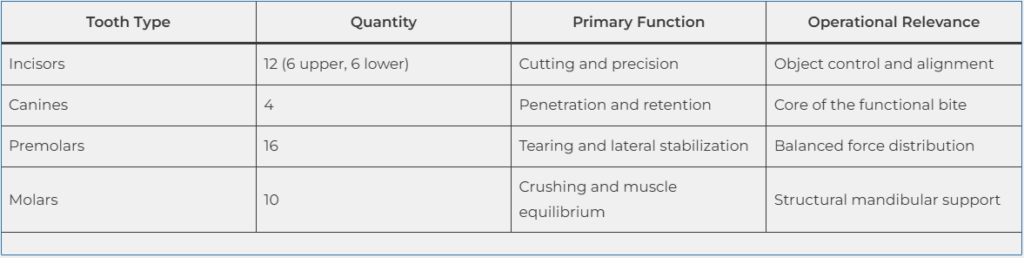
An adult dog has 42 permanent teeth, symmetrically distributed between the upper (maxillary) and lower (mandibular) arches. Each category serves a specific and interdependent role:
Muscular Coordination and Bite Mechanics
The efficiency of canine dentition depends not only on the teeth themselves but also on the coordinated action of the jaw muscles that drive bite power and precision.
Three primary muscles are responsible for generating and stabilizing the mechanical force of the bite:
- Temporal muscle: provides vertical closure strength and contributes to maintaining sustained bite pressure.
- Masseter muscle: produces lateral and vertical compression, converting muscular contraction into direct bite force.
- Pterygoid muscle: stabilizes jaw movement and prevents torsion during lateral resistance.
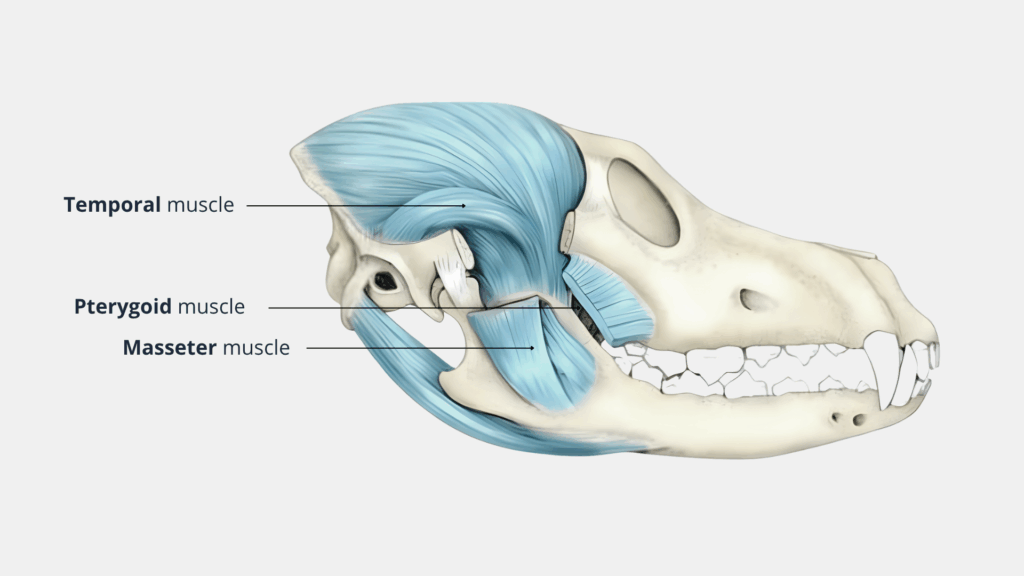
Together, these muscles form the biomechanical foundation of canine dentition, transforming neuromuscular energy into precise, repeatable movement.
This coordination ensures that the dog’s bite is not a simple reflex, but a controlled motor action, balancing power, alignment, and endurance.
(In practical terms, this means a working dog with healthy masticatory muscles and proper occlusion can exert high bite pressure with less fatigue and greater stability, essential for protection, search, and sport performance.)
Bite Biomechanics and Occlusal Patterns
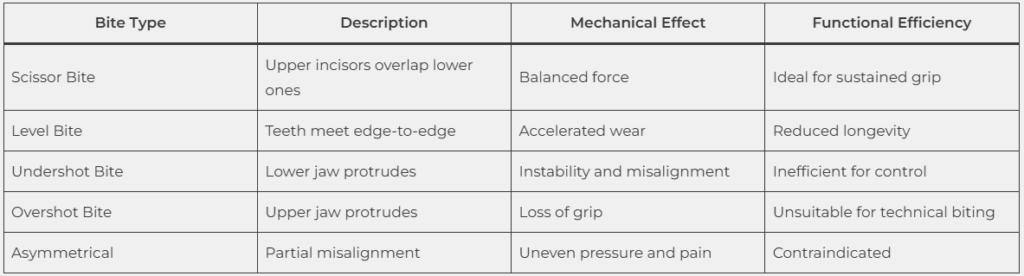
Functional occlusion, or how the teeth meet, determines both efficiency and durability of the bite. The ideal pattern, the scissor bite, occurs when upper incisors slightly overlap the lower ones, ensuring continuous force with minimal friction.
Dental Health and Performance
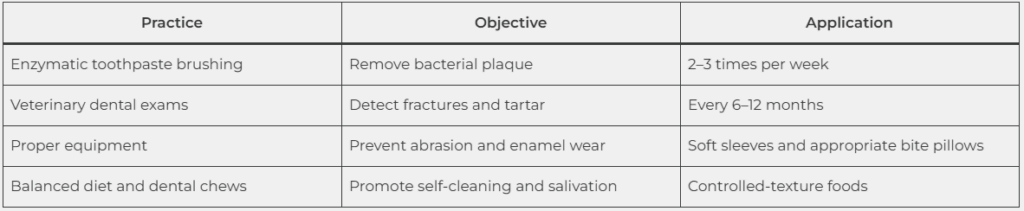
Over 80% of adult dogs develop some form of periodontal disease by age three. Gingivitis, fractures, and infections reduce bite strength and may cause hesitation during exercises.
Thus, dental health in working dogs is a functional necessity, not a cosmetic concern.
Genetic Selection and Functional Conformation
Genetics largely define cranial and dental morphology.
Brachycephalic breeds (short-muzzled) often present prognathism and occlusal distortion, which make them less suitable for technical bite work.
Conversely, mesocephalic and dolichocephalic breeds, such as Belgian Malinois and German Shepherds, exhibit symmetrical arches ideal for both power and control.
Breeding programs for working dogs should incorporate radiographic and dental evaluations to ensure functional alignment and minimize hereditary malocclusions.
Scientific Evidence on Cranial Conformation and Functional Health
Recent research underscores the direct link between cranial conformation and functional health in dogs.
A study published in Nature (Scientific Reports, 2020) analyzed 22,333 dogs under veterinary care in the UK and found that brachycephalic breeds, characterized by shortened muzzles and compact jaws, exhibited significantly higher rates of oral and respiratory disorders compared to breeds with balanced morphology.
These conditions impair ventilation (the body’s ability to exchange air efficiently during physical effort) and thermoregulation (the process that enables temperature control and heat dissipation during work).
When these systems are compromised, oxygen delivery decreases, leading to muscular fatigue, stress, and reduced performance.
Biomechanically, shortened facial structures alter the angle of insertion of the masticatory muscles and reduce the mandibular lever arm, weakening force distribution and increasing the likelihood of dental fractures and joint dysfunctions.
(This explains why brachycephalic dogs like Bulldogs or Pugs struggle during sustained gripping or traction tasks, while intermediate skull types maintain stability between power, control, and respiratory function.)
These findings reinforce that canine dentition and cranial health must be treated as biomechanical criteria of selection, not aesthetic ones.
Conclusion
Canine dentition is an integrated system that reflects the harmony between structure and motor intelligence.
Dogs with well-aligned teeth, symmetrical arches, and healthy mouths demonstrate superior efficiency, reduced wear, and consistent performance across working disciplines.
Preserving canine dental health means preserving function, safety, and longevity.
Therefore, breeding and selection programs should prioritize clinical evaluations, radiographic exams, and occlusal analysis before breeding. As discussed in Ideal genetic selection for working dogs: What to consider, responsible genetic planning must go beyond visual standards to include biomechanical, neurological, and health-based assessments that sustain real working capability.
The goal should not be merely visual conformity, but the biomechanical functionality of the bite, ensuring that future generations retain the strength, control, and precision that define a true working dog.
(Ultimately, caring for dentition means safeguarding one of nature’s finest instruments, the connection between instinct, cognition, and performance.)