
Reactive dogs are not unstable or dominant, they are hypersensitive to an environment that no longer makes sense to them.
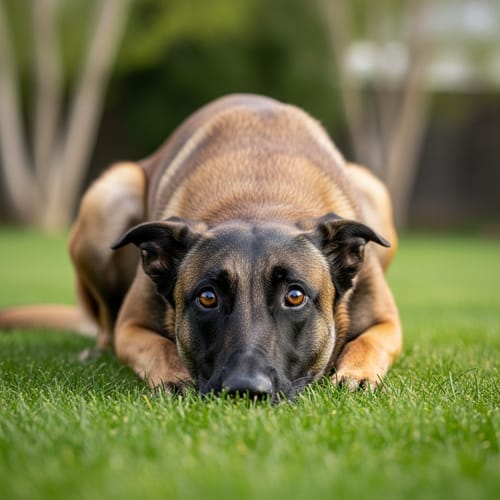
Pako, a two-year-old Malinois, arrived for evaluation after developing intense responses in public spaces.
During walks, just seeing another dog or hearing approaching footsteps triggered visible tension: his body froze, eyes locked, and breathing changed.
It was the reflection of a brain conditioned to constant vigilance.
What looked like “difficult behavior” was, in fact, a nervous system trained by unpredictability.
Reading the Body Before Reading the Behavior
Before any intervention, the trainer focused on observation.
Pako reacted more when moving directly from his calm home environment into busy areas such as sidewalks or parks.
The pattern was always the same: visual fixation, muscle tension, increased respiration, and vocalization.
There was no pause between perception and response.
From an ethological perspective, the behavior revealed a disruption between observation and interpretation.
Pako’s brain had learned that unfamiliar stimuli equal potential danger, and that reacting first is safer than assessing.
The goal was to rebuild that process step by step.
Step One: The Body Before the Environment
A dog in a state of alert cannot learn.
That’s why the work began far from the stimuli that triggered reactivity.
In the first sessions, the focus was not on “getting used to” the park, but on teaching the body to exit the defensive state.
Pako performed simple field routines: straight-line walks, slow turns, short olfactory pauses.
The goal was to burn energy while stabilizing physiology, steady breathing, rhythmic movement, balanced muscle tone.
Only after his body relaxed would he be taken to more demanding environments.
This sequence has neurophysiological logic: mild aerobic exercise lowers activity in the reticular system and allows cortical control over emotion to re-engage.
Practically speaking, a dog who is physically regulated interprets stimuli more coherently.
It’s not about “tiring him out,” but about lowering the neural baseline of arousal.
Step Two: Planned Exposure and Distance Control
Once balanced, Pako began controlled exposure to the triggers, always under three strict rules:
- Safe distance: he must see the stimulus without crossing his reactivity threshold.
- Short duration: each exposure lasted only a few minutes.
- Predictable exit: the trainer withdrew before any reaction, never after.
Meanwhile, the handler maintained a constant rhythm and neutral tone.
If Pako fixated on something, he was gently cued to move, to walk, turn, or sniff the ground.
The goal was to replace the typical motor block of reactivity with controlled action.
Each session ended at the same starting point, always in the same sequence.
This structure creates predictable memories.
The brain starts linking the trigger (a dog, a bicycle, a sound) with a neutral, repetitive outcome.
Gradually, the expectation of threat fades.
Step Three: Routine as an Emotional Reference
Reactivity rarely stays confined to one context.
For that reason, the trainer rebuilt Pako’s entire routine around stable patterns:
feeding at fixed times, walks of equal length and pace, consistent cues and gestures.
Predictability becomes the framework for neural reorganization.
Each repetition strengthens the hippocampus (which connects context and memory) and reduces the need for defensive activation.
When the dog recognizes what follows each event, the brain decreases vigilance output.
In ethological terms, this is the reconstruction of territorial sense.
The environment stops being interpreted as random and becomes a source of safety again.
Step Four: Controlled Autonomy
As stability grew, Pako was allowed small decisions during walks, choosing to pause, to change direction, or to keep moving.
These micro-choices give the brain a sense of control, essential for self-regulation.
Neuroscientifically, when an animal acts and perceives a predictable consequence, the communication between the orbitofrontal cortex and the nucleus accumbens strengthens, producing calm and engagement.
Predictability is no longer external (coming from the human), but internal (generated by the dog himself).
Step Five: Generalization and Rebuilding Confidence
After four weeks, Pako could visit the same park where he used to react to every sound or sight.
The difference was the protocol: exercise first, calm environment, consistent cues.
When he saw other dogs, he briefly looked, then redirected and continued walking.
These subtle behaviors marked emotional self-regulation.
The brain had relearned to classify before responding.
Vigilance gave way to analysis, visible in small physiological details: relaxed ears, steady breathing, fluid tail movement.
From an ethological point of view, Pako had returned to an exploratory state, the opposite of defense.
His nervous system had re-established communication between perception, emotion, and movement.
The Science of Calm
Reactivity is a problem of interpretation, not disobedience.
The process doesn’t aim to “desensitize” but to rebuild the conditions for correct perception.
Each stage of Pako’s rehabilitation illustrates the principle:
- Regulate the body before facing stimuli.
- Expose under full control of time and distance.
- Repeat coherent sequences to anchor predictability.
- Offer limited decisions to rebuild autonomy.
Together, these elements don’t suppress instinct, they reorganize its expression.
A brain that understands its environment no longer needs to react; it simply responds.
This case study is part of the Dog Rehabilitation category, which gathers research and practical applications on emotional recovery, predictability, and neurobehavioral balance in working dogs.