
The hierarchical bond in dogs is the invisible foundation that supports obedience and emotional stability.
More than coexistence or affection, it represents a social and cognitive structure in which the dog recognizes the handler as the central point of safety, guidance, and stability.
In working dogs, this bond defines the balance between instinct and control, ensuring emotional clarity under pressure, focus in unpredictable environments, and resilience during stress.
A dog that understands this natural hierarchy doesn’t need constant correction, it chooses to cooperate, because its biology associates the leader with environmental predictability.
The Foundation of the Hierarchical Bond
The hierarchical bond is not imposed, it is built.
Every daily interaction, feeding, movement, rest, play, and spatial control, teaches the dog who controls the environment.
In the canine mind, the leader is the one who manages resources and space with calm consistency.
Leadership is not domination.
It means providing emotional predictability.
When the human is stable and consistent, the dog relaxes and responds naturally.
When there is insecurity, the animal tries to fill the social vacuum, which can result in anxiety, hypervigilance, or control-seeking behavior.
The hierarchical bond in dogs is therefore both emotional and cognitive, it arises from trust, is consolidated through coherence, and manifests as behavioral balance.
The Natural Lesson, The Puppy and Its Reference Point
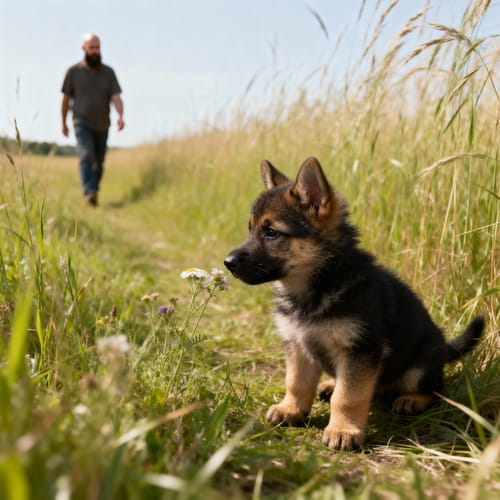
Imagine a trainer taking a working puppy to a large, safe open field. With a loose leash, the puppy is free to explore, run, and wander. At some point, it realizes the handler is no longer right behind; the dog pauses, looks around, whines, uncertain. The trainer doesn’t rush back, he allows the puppy to experience the brief discomfort of losing its reference. After a few seconds, he calls the puppy in a calm, steady tone, and the reunion brings relief and stability. In that moment, the dog’s brain learns something fundamental: safety exists near the leader. No punishment, only emotional learning through association. From that day on, the puppy begins to stay close voluntarily and watch the handler naturally. That is the first step of the hierarchical bond, the leader becomes the axis of stability, not the source of control.
The Dog’s Brain, Neuroscience of Leadership and Trust
Neuroethological research shows that consistent social relationships modulate stress and motivation systems.
In the hierarchical bond, several brain systems work together:
Oxytocin: Facilitates social affiliation, reduces cortisol, and helps the dog perceive the handler as a safe context.
Dopamine: Regulates motivation and goal-seeking behavior. It’s released when the dog engages, follows, or maintains proximity to the leader with positive expectation.
Amygdala: Evaluates relevance and threat; with predictable leadership, it reduces defensive reactivity.
Hippocampus: Provides spatial and contextual memory, allowing the dog to recognize safe situations and patterns of leadership.
Prefrontal Cortex: Governs impulse control and focus under distraction, sustaining goal-directed attention toward the handler.
Together, these systems reshape the dog’s emotional threshold.
The dog begins to want to stay near the leader, not for external reward, but because that presence organizes the world.
Obedience becomes not a reaction, but a motivated decision within a stable emotional framework.
The Ethological Basis, The Instinct of Hierarchy
Ethology shows that hierarchical behavior is an inherited trait of wild canids.
Pups follow and imitate adults who control movement, food, and protection, a pattern preserved through evolution because it increases survival.
In domestic or working settings, the handler assumes that role.
When calm and consistent, the human is recognized instinctively as a stable authority.
When unpredictable, the dog attempts to assume control, leading to insecurity or conflict.
True leadership is not about strength, but about predictability.
Dogs follow those who are emotionally stable, because, biologically, stability equals safety.
From Hierarchy to Obedience, When Following Becomes Choice
In any training program, obedience must come after the bond.
Commands taught before trust are mechanical; commands taught after trust are meaningful.
When there is a hierarchical bond, obedience becomes a social decision, a form of voluntary cooperation.
The dog obeys not out of fear, but out of choice, it understands that following the leader is the safest and most coherent path.
Only after this emotional foundation is established should technical training begin, ensuring obedience built on trust, not submission.
See also: Dog Training Category
Training exercises are most effective when obedience arises from leadership and emotional stability.
Practical Exercises to Strengthen the Hierarchical Bond
1. Free Following
Walk with the dog using a loose leash, encouraging voluntary attention rather than control.
The goal is natural engagement, not physical correction.
2. Resource Control
Manage access to food, play, and rest.
To the dog, whoever controls resources controls predictability and safety.
3. Movement Rituals
Teach the dog that movement starts from the handler’s cue.
This builds impulse regulation and environmental discipline.
4. Controlled Exposure
Introduce new stimuli (sounds, people, environments) while maintaining handler focus as the emotional anchor.
This develops resilience and controlled curiosity.
5. Silent Communication
Body language, posture, and coherence transmit confidence.
Dogs recognize calm authority without needing constant verbal reinforcement.
These exercises create a natural, balanced hierarchy based on clarity and consistency, not fear or coercion.
Signs of a Solid Hierarchical Bond
A well-bonded dog demonstrates:
- Voluntary proximity to the handler;
- Synchronized movement and attention;
- Quick recovery from distractions;
- Calm behavior in unfamiliar places;
- Focused attention on the leader rather than random stimuli;
- Peaceful acceptance of limits and structure.
These behaviors show emotional and cognitive integration — the dog understands and trusts its social role.
Emotional Impact of Stable Leadership
Predictable leadership acts as an emotional regulator.
Dogs with strong hierarchical bonds exhibit lower stress hormone variation, greater stimulus tolerance, and faster recovery after arousal.
The brain learns that the leader provides environmental control, reducing hypervigilance.
In practical terms, this means clarity under pressure.
A search dog remains focused amid chaos; a protection dog reacts only when appropriate; a sport dog performs confidently before crowds.
The bond transforms instinct into deliberate action.
The Risk of Inconsistent Leadership
Inconsistent handlers weaken the hierarchy.
Dogs sense emotional instability instantly.
If the owner alternates between harshness and permissiveness, the dog loses reference, developing insecurity or impulsivity.
Over-humanization has similar effects.
When owners avoid setting boundaries out of guilt, they remove the structure the dog’s brain needs to feel safe.
Without hierarchy, there is no predictability, and without predictability, no emotional stability.
Conclusion, Hierarchy as the Core of Obedience
The hierarchical bond in dogs is the unseen core of functional obedience.
It does not arise from commands, but from consistency, stability, and trust.
It turns the human–dog relationship into a predictable system in which the dog follows because it chooses to, not because it fears.
When leadership is calm and coherent, learning becomes effortless, emotions remain stable, and performance becomes reliable.
True obedience in every context emerges when the dog sees the leader as the point of balance between instinct and reason.