
Introduction
The 3 Pillars of Foundational Training, desensitization, habituation, and socialization, form the behavioral and emotional framework of any stable and functional working dog.
This article focuses on the first and perhaps most complex of these pillars: desensitization in dogs.
Desensitization in dogs is the process of reducing sensitivity to stimuli that once triggered fear, discomfort, or excessive reactivity. In working dogs, desensitization is a key part of foundational training that allows them to remain calm, functional, and focused under pressure.
For working dogs, such as police, military, protection, detection, or search-and-rescue dogs, desensitization is not just a technique: it’s a behavioral foundation. These dogs operate in unpredictable conditions: loud noises, crowds, explosions, strong odors, other animals, and varied human interaction.
Without guided desensitization, a dog may lose focus, react impulsively, or even abandon its task in critical moments.
Understanding this process is essential not only for trainers and handlers but also for anyone interested in canine behavior, neuroscience, and applied ethology.
Below, we’ll explore the scientific principles, neurobehavioral mechanisms, and practical application of desensitization in dogs, as well as how it integrates with the other foundational pillars.
Conceptual Foundations of Desensitization
In behavioral science, desensitization originates from classical associative psychology, developed through the work of Joseph Wolpe (1958), a pioneer of systematic desensitization.
In dogs, the principle is the same: gradual exposure to a stimulus that causes fear or overexcitement, under controlled conditions, until the animal begins to associate that stimulus with neutrality or positivity.
It’s important to differentiate desensitization from habituation.
While habituation occurs naturally, when a neutral stimulus loses significance over time, desensitization requires technical planning and environmental control.
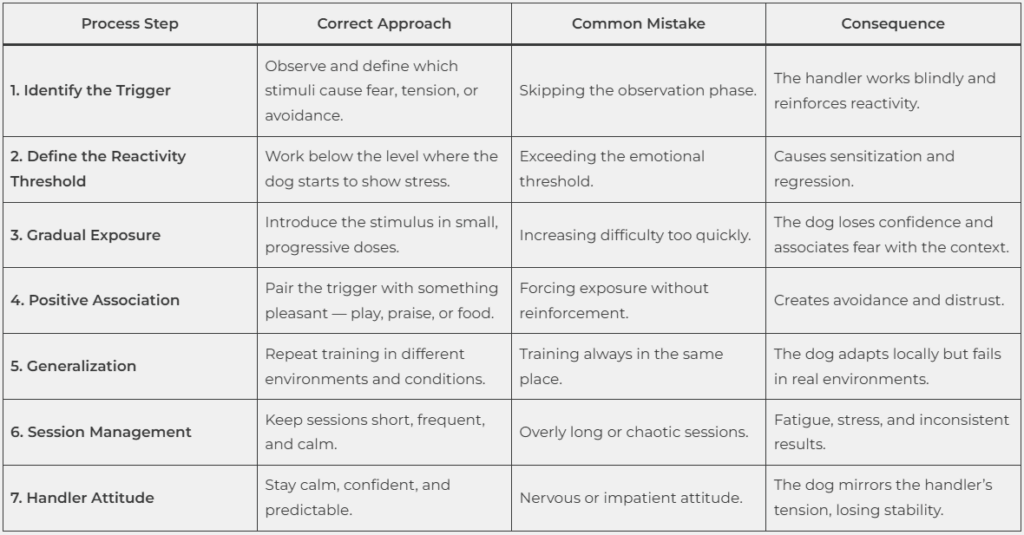
The stimulus is not neutral; it triggers emotion. Therefore, it must be introduced progressively, respecting the dog’s emotional threshold.
If that threshold is exceeded, the process breaks down, and the stimulus regains its ability to provoke fear, insecurity, or aggression.
Desensitization is therefore a process of emotional reconditioning.
The dog doesn’t stop perceiving the stimulus, it learns to interpret it differently.
Instead of reacting impulsively, it understands that the stimulus poses no threat and can be faced with calmness and confidence.
Neurobehavioral Basis of Desensitization
To understand why desensitization in dogs is so effective, we must look at the neurobiological mechanisms underlying behavior.
When a dog is exposed to an aversive stimulus, such as gunfire, sirens, or crowds, there is an immediate activation of the limbic system, particularly the amygdala, which processes fear and triggers the “fight or flight” response.
This activation releases hormones such as adrenaline and cortisol, preparing the body for instinctive action.
During desensitization, the dog is exposed to the same stimuli gradually and under safe, controlled conditions.
Over time, the brain reinterprets these experiences, reducing amygdala activation and strengthening neural pathways in the prefrontal cortex, the area responsible for emotional regulation and decision-making.
This process represents true neuroplasticity, the brain’s ability to reorganize and form new neural connections through learning and experience.
A study published in Scientific Reports (Nature, 2019), “Interaction between genes related to blood-cell neuroplasticity and environmental enrichment in working dogs” provides strong scientific support for this concept.
Conducted with Italian Guardia di Finanza working dogs, the research demonstrated that training and environmental enrichment influence the expression of genes associated with neural plasticity, such as BDNF, NGF, and IGF.
These genes regulate synaptic formation, emotional control, and adaptive learning.
Although the researchers analyzed blood samples, these same genes are also active in the central nervous system, meaning that their presence in blood reflects neural adaptation processes in the brain.
In other words, blood served as a “biological window” to observe how controlled, positive stimuli activate molecular pathways related to learning and emotional resilience.
Thus, desensitization is not merely behavioral training but a form of structured neural stimulation, capable of modifying how the brain interprets environmental information.
The dog doesn’t just “tolerate” stimuli, it processes them cognitively, with self-control and confidence.
For working dogs, this means transforming impulsivity into control, fear into predictability, and stress into balanced performance.
Difference Between Desensitization and Habituation
Although often confused, desensitization and habituation are distinct processes.
- Habituation: a non-associative process in which the dog stops reacting because the stimulus becomes irrelevant.
Example: a dog living near a busy street learns to ignore the constant sound of traffic. - Desensitization: an associative and emotional process in which the dog must relearn that the stimulus it once feared is harmless.
Example: a dog that fears thunder learns, through controlled exposure to similar sounds, that no danger exists.
While habituation occurs naturally over time, desensitization requires technical guidance, behavioral observation, and intensity control.
Both complement each other: habituation supports everyday adaptation, and desensitization targets deeper emotional reactivity.
Desensitization in Puppies
Desensitization in puppies is the starting point for developing emotional balance.
During the sensitive socialization period, between 3 and 14 weeks of age, the nervous system is rapidly developing, and early experiences directly shape emotional stability and adaptability.
A puppy exposed to the world safely and positively tends to grow into a confident adult; one deprived of structured sensory experience may develop excessive fears and poor coping ability.
The breeder or trainer acts as a mediator between the puppy and the environment, introducing sounds, textures, people, and stimuli gradually and positively.
Each new experience should include positive reinforcement, building trust and curiosity rather than avoidance.
Early Sensory Desensitization
Working dogs must develop a wide sensory repertoire.
That means early, controlled exposure to varied sounds, surfaces, odors, and visual settings.
- A detection dog should be familiar with natural smells such as wet soil, vegetation, and smoke.
- A protection or patrol dog must adapt to urban sounds, metallic noise, engines, and human scent variability.
The goal is to normalize the environment, making each new stimulus a predictable part of reality.
Familiarity reduces stress and builds environmental resilience, essential for operational confidence.
Intensity Control and Positive Association
The golden rule in desensitization in dogs is: never exceed the emotional threshold.
Stimuli must be introduced at tolerable levels, paired with positive reinforcement such as food, affection, or play.
The handler’s attitude is key, calm, patient, and consistent.
Each positive experience reinforces emotional control and strengthens trust between dog and trainer.
This method develops dogs that are curious, stable, and courageous, rather than impulsive or fearful.
Multisensory Desensitization
Effective desensitization integrates all senses.
Working on different surfaces (sand, wood, metal, concrete), listening to various sounds (rain, footsteps, engines), and observing diverse visual elements (people, equipment, vehicles) enhances neural integration and proprioceptive balance.
This multisensory desensitization produces dogs that are emotionally, cognitively, and physically stable, traits fundamental for real-world performance.
Building the Emotional Foundation for Work
Desensitization is more than acclimation, it’s emotional education.
Dogs trained with structure and patience develop self-regulation, stress recovery, and focused composure.
Overexposure or unstructured intensity, however, can cause hypersensitivity instead of resilience.
Progress must be gradual, guided by body language observation, tail, ears, eyes, and breathing reveal the dog’s comfort zone.
A well-desensitized dog doesn’t just face the world, it trusts it.
That trust forms the emotional backbone of every functional working partnership.
Integration with Other Training Processes
Desensitization in dogs is one of the three pillars of foundational training, alongside habituation and socialization.
- During socialization, the dog learns to interact with the world.
- Through habituation, it adapts to neutral, everyday stimuli.
- In desensitization, it learns to stay emotionally balanced in the face of challenge.
These processes interact and complement each other, forming the emotional and cognitive foundation of the working dog.
(The other two articles in the series Habituation in Dogs and Socialization in Dogs can be found in the Skills category.
Ethical Considerations and Animal Welfare
Desensitization is not about forcing endurance.
Fear and anxiety are biological responses, not behavioral flaws.
An ethical approach respects each dog’s pace, avoids emotional overload, and prioritizes trust and autonomy.
When properly applied, desensitization reduces suffering and enhances welfare, strengthening the partnership between dog and handler.
Conclusion
Desensitization in dogs is one of the most sophisticated pillars of modern canine training.
More than a behavioral technique, it is a process of emotional and neurobiological education, transforming instinctive reactions into controlled, goal-driven responses.
Through structured exposure and positive reinforcement, the dog’s brain rewires itself for balance and focus, strengthening self-control and emotional stability.
This transformation distinguishes a reactive dog from a functional one, a dog capable of thinking, interpreting, and responding with composure.
Applied with science, patience, and empathy, desensitization elevates working dogs to a level of operational excellence and emotional wellbeing, representing the true convergence of neuroscience, behavior, and trust.