
Habituation in dogs is a core process of neurobehavioral learning that defines how a canine perceives, interprets, and reacts to its environment.
Rather than merely “getting used” to something, habituation represents an active neurological adaptation, the brain’s ability to filter irrelevant stimuli and respond only to what truly matters for survival or work performance.
In high-stimulation contexts, guard, detection, rescue, assistance, or sport work, this process is what separates emotional control from sensory overload.
A well-habituated dog maintains focus and composure amid sirens, movement, or human activity, while a poorly habituated dog burns energy reacting to every sound or motion, losing precision and stability.
From the standpoint of neuroscience and applied ethology, habituation forms the first sensory-emotional filter of the canine brain, the foundation upon which all other learning is built.
As Daniel T. Blumstein (2016) observed in “Habituation and Sensitization: New Thoughts on Old Ideas” (Animal Behaviour), this is not a passive process it’s a neuroadaptive mechanism refined through evolution to optimize behavioral efficiency.
1. Scientific Origins and Adaptive Role of Habituation in Dogs
The concept of habituation emerged from early experimental psychology and has been confirmed across virtually every animal species.
In dogs, it appears naturally during development: puppies exposed to neutral but repetitive stimuli grow into adults with greater emotional resilience and behavioral predictability.
Habituation in dogs plays a vital evolutionary role, it conserves emotional energy, reduces unnecessary stress, and allows the animal to reserve its reactions for genuine threats or opportunities.
In working contexts, this translates into operational clarity, where a dog’s attention stays aligned with its task, regardless of environmental chaos.
While desensitization (see the 1st Pillar of Foundational Training: Desensitization in Dogs) focuses on changing the emotional response to specific fears, habituation reshapes the perception system itself, teaching the brain what not to react to.
2. Neurobiological Foundations of Habituation
At the neural level, habituation in dogs is a product of synaptic plasticity, the brain’s ability to modify how neurons communicate after repeated, non-threatening exposure.
Each time a neutral stimulus occurs without consequence, the brain releases less glutamate, the main excitatory neurotransmitter, lowering the activation of the amygdala and limbic circuits.
Other key neuromodulators shape this process:
- Serotonin maintains emotional stability and impulse control.
- Dopamine focuses attention and reinforces relevant information.
- GABA inhibits excessive excitation, preventing hyperreactivity.
Core brain structures involved include:
- Amygdala: assesses emotional salience and moderates fear.
- Hippocampus: recognizes familiar stimuli and contextual patterns.
- Prefrontal Cortex: controls inhibition and behavioral precision.
- Sensory Cortex: filters sensory input to determine relevance.
Over time, repetition leads to active emotional neutrality, the dog still perceives the stimulus but no longer reacts, sustaining alertness without stress.
This neural balance underlies focus, endurance, and controlled behavior in complex operational settings.
3. Types of Habituation in Dogs
Habituation in dogs manifests across multiple sensory dimensions and must be trained systematically:
- Auditory Habituation: adapting to sirens, gunfire, machinery, or city noise.
- Visual Habituation: remaining calm amid motion, crowds, or flashing lights.
- Olfactory Habituation: ignoring non-target odors during detection or tracking.
- Contextual Habituation: adapting to environments such as vehicles, rubble, stairs, or confined spaces.
These layers often overlap, demanding multisensory exposure and consistent reinforcement to develop a stable, reliable canine temperament.
4. Difference Between Habituation and Desensitization
Though frequently mistaken for one another, these two learning mechanisms operate at different levels.
Habituation in dogs alters perception and attention, while desensitization transforms emotional meaning.
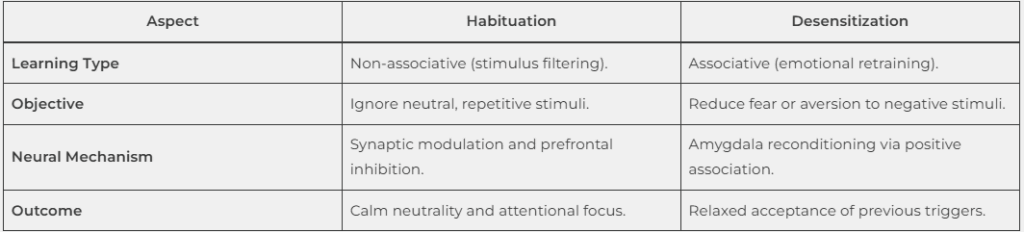
Together, these processes build the core of emotional self-regulation.
The habituated dog learns what to ignore, while the desensitized dog learns what not to fear both essential for functional performance.
5. The Process of Controlled Habituation
Building habituation in dogs requires a structured, incremental process grounded in predictability and timing.
Core Stages:
- Select the stimulus: choose something neutral yet relevant (e.g., siren sound, moving object).
- Start at low intensity: brief, distant, and controlled.
- Repeat with consistency: present without consequence until the response diminishes.
- Gradually increase exposure: bring the stimulus closer or louder while maintaining calm.
- Combine with obedience tasks: integrate commands to reinforce focus and control.
- Reward calm behavior: mark and reinforce emotional neutrality.
- Generalize: apply the same exercise in varied environments.
- Maintain periodically: schedule regular exposure to prevent dishabituation.
Each repetition reshapes neural thresholds, gradually teaching the dog what is safe to ignore, solidifying confidence and focus.
6. Applications of Habituation in Dogs
In working dogs, habituation enhances operational reliability:
- Guard dogs filter constant city noise.
- Police dogs stay composed during sirens and crowds.
- Rescue dogs remain functional in chaotic disaster zones.
- Detection dogs ignore irrelevant odors or distractions.
In companion dogs, the same mechanism promotes social stability and adaptabilit, calmness during household noises, traffic, or unfamiliar visitors.
The difference lies only in stimulus intensity and purpose, not in the underlying neurological process.
7. Common Mistakes in Habituation Training
Errors in the application of habituation in dogs often stem from misjudging emotional thresholds:
- Presenting the stimulus too intensely or too soon.
- Lacking repetition or predictability.
- Punishing reactive behavior instead of redirecting it.
- Extending sessions beyond the dog’s attention capacity.
- Neglecting maintenance sessions, causing reactivity to return.
Effective habituation training demands consistency, observation, and empathy a balance of exposure, timing, and control.
8. Conclusion: The Sensory Pillar of Canine Stability
Habituation in dogs is the sensory foundation of emotional balance and focus.
It trains the brain to prioritize, conserve energy, and stay composed under pressure.
Without it, learning becomes unstable, the dog reacts before it thinks.
When combined with desensitization (fear regulation) and socialization (interaction balance), habituation completes the three pillars of foundational training, a model of emotional control and behavioral reliability.
As Daniel T. Blumstein (2016) emphasized in his paper “Habituation and Sensitization: New Thoughts on Old Ideas” (Animal Behaviour), habituation is not a passive process but an evolutionary mechanism of neural adaptation that allows animals to manage information and emotion efficiently.
For further reference, see the full publication available through Elsevier on ScienceDirect:
Habituation and Sensitization: New Thoughts on Old Ideas (Blumstein, 2016)
Understanding habituation means understanding how the brain learns not to react, the defining difference between a sensitive dog and a truly confident one.