

Introduction: From Biology to Behavior
Ontogenetic Periods of the Dog represent the sequence of biological and behavioral transformations that shape every stage of a dog’s life.
From birth to senior age, the canine brain and behavior evolve through a dynamic interaction between genetics, epigenetics, and environmental experience.
Ontogenesis explains how genetic information becomes functional reality, how inherited potential is expressed, modified, or silenced through lived experience.
While genetics provides the blueprint, the environment determines when and how that blueprint is activated.
For a deeper understanding of how selection refines this biological foundation, see Genetic Selection for Working Dogs.
Ontogenetic development is, therefore, the biological mechanism that transforms genetic predisposition into observable temperament, cognition, and behavior.
Recognizing and respecting each ontogenetic period is fundamental for breeders, trainers, and canine professionals who aim to build dogs that are emotionally stable, cognitively resilient, and behaviorally consistent.
1. Neonatal Period (0–2 Weeks)
Newborn puppies are blind, deaf, and entirely dependent on maternal care.
The nervous system is immature, and all actions are reflexive.
Core stimuli such as warmth, touch, and maternal scent activate epigenetic processes that regulate hormonal balance through the hypothalamic–pituitary–adrenal (HPA) axis.
Gentle, consistent human handling during this time can reduce future reactivity and improve tactile tolerance.
Negative or stressful events, however, can leave lasting neurochemical imprints that alter emotional regulation in adulthood.
In the neonatal period, the environment doesn’t teach, it programs the organism’s physiological responses to the world.
2. Transitional Period (2–4 Weeks)
This is the beginning of sensory awareness.
The eyes open, hearing develops, and the puppy begins to explore its surroundings.
At the neural level, myelination accelerates, improving communication between brain regions and laying the groundwork for learning.
A clean, stable, and predictable environment is essential.
Overstimulation, loud noises, or unpredictable handling may trigger early epigenetic activation of stress circuits.
The transitional period marks the shift from reflexive reaction to sensory perception, the first step in conscious learning.
3. Socialization Period (3–12 Weeks)
This is the phase of maximum neural plasticity in the dog’s life.
Every experience during this window molds the architecture of the brain, influencing emotional control, confidence, and adaptability.
Effective socialization means gradual, positive, and diversified exposure to people, sounds, surfaces, objects, and other animals.
Predictable experiences paired with positive reinforcement build resilience and trust.
Punishment or chaotic exposure at this age can lead to lifelong fear responses and insecurity.
Scientific studies on the ontogeny of social play reveal that between 3 and 13 weeks, playful behaviors, gentle biting, rolling, mounting, and alternating dominance, serve as early exercises in emotional regulation and social communication.
These interactions prepare the brain for cooperation, inhibition, and group coordination.
(Reference: Pal, 2010 – Development of Social Play in Free-Ranging Dog Puppies)
What is learned during this period becomes embedded as emotional memory, shaping how the adult dog interprets and responds to the world.
4. Juvenile Period (3–6 Months)
The juvenile phase is characterized by exploration and cognitive expansion.
The prefrontal cortex, responsible for impulse control and decision-making, begins to mature, allowing the dog to understand social boundaries and consequences.
Short, structured, and consistent training sessions encourage adaptive learning without frustration.
Environments that offer balance between predictability and challenge promote emotional regulation and attention stability.
Inconsistent or punitive handling can interrupt emotional maturation and produce unstable responses.
The juvenile stage consolidates habits, shapes problem-solving ability, and refines social awareness.
5. Maturation Period (6–18 Months)
The canine brain reaches adult structure and hormonal stability.
Neural plasticity decreases, and behavioral patterns become consistent.
This is when instincts, training, and experience begin to merge into functional behavior.
It is the ideal period for advanced and task-specific training, such as detection, protection, or search and rescue.
Balanced reinforcement ensures that learning strengthens self-confidence instead of anxiety.
The maturation period defines the emotional architecture and long-term reliability of the working dog.
6. Adult Phase (18 Months to 7 Years)
This stage represents the peak of neurobiological and behavioral efficiency.
The adult dog exhibits stable temperament, high endurance, and consistent cognitive performance.
Although major structural changes in the brain are minimal, epigenetic regulation remains active, meaning that training and social experiences continue to shape gene expression.
Sustained mental stimulation, problem-solving activities, and physical exercise preserve functional neural circuits.
For working dogs, this phase is the apex of operational performance, where instinct and control coexist seamlessly.
Neglect or chronic stress, however, can trigger premature cognitive or emotional decline.
The adult dog embodies the complete outcome of its ontogenetic journey.
7. Senior Period (7+ Years)
Aging is the final stage of ontogenetic development.
Metabolic and cognitive processes slow, and sensory precision diminishes.
Despite that, experience and environment continue to influence gene expression through epigenetic mechanisms.
Stable routines, gentle cognitive challenges, and ongoing social contact maintain emotional well-being and neural health.
Positive experiences even in advanced age strengthen synaptic pathways related to confidence and trust.
Healthy aging is not merely genetic, it is the biological reflection of a well-managed ontogenetic history.
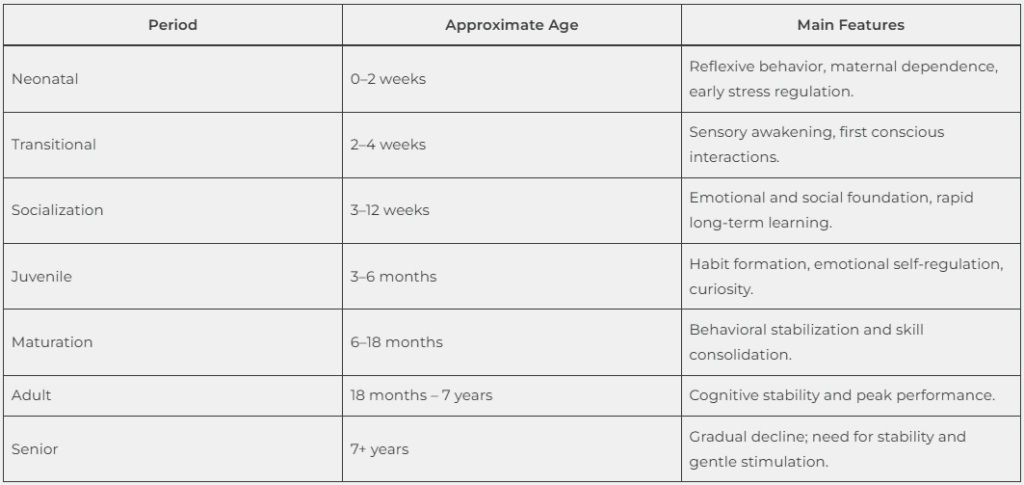
Summary of Ontogenetic Periods of the Dog
Epigenetics and Environment: The Hidden Architects
Throughout every ontogenetic period, epigenetic modulation determines how genes are expressed in response to experience.
Stable, enriching environments enhance neural plasticity and emotional balance.
Unpredictable or punitive conditions activate circuits of fear and reactivity.
Training, therefore, is not only behavioral, it is a biological act that reshapes gene expression through experience.
The dog’s balance and resilience are determined by the quality of its ontogenetic development, not by genetics alone.
Conclusion
The ontogenetic periods of the dog demonstrate that behavior, cognition, and emotional health are products of continuous biological adaptation.
From neonatal dependency to senior decline, each phase represents a unique opportunity to shape the canine mind.
To respect ontogeny is to train with science, aligning genetics, epigenetics, and environment into a single adaptive process.
True excellence in working dogs arises when biology, neuroscience, and training coexist in perfect synergy.