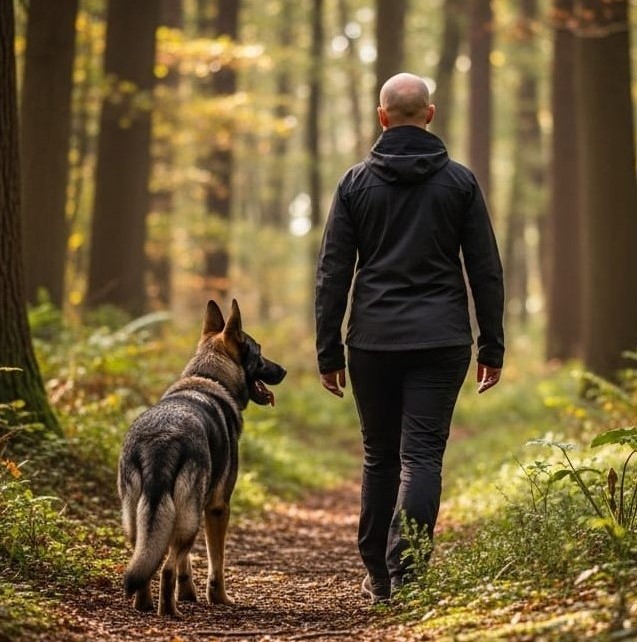

Dog socialization is the process through which the canine brain learns to coexist with the world without losing balance.
It goes beyond simple exposure to people, sounds, or environments, it is a neurological education in social interpretation, a cognitive process that teaches the dog how to distinguish between what is predictable, novel, or truly threatening.
For working dogs, socialization defines the difference between reactivity and discernment.
A socialized dog does not ignore the world, it understands it with stability.
That comprehension, built through structured coexistence, transforms into focus, confidence, and emotional control — the foundation of functional behavior.
Socialization as the Emotional Code
All social behavior is guided by emotion.
When a dog encounters a new stimulus, a person, another animal, a sound, the brain must decide whether to react with approach, neutrality, or defense.
That judgment is not instinctive; it is learned through socialization.
During early interactions, the limbic system, especially the amygdala and hippocampus, records emotional patterns.
Each positive or neutral experience reduces uncertainty, while each negative one imprints defensive tendencies.
Therefore, socialization is not “showing the world” to the puppy; it is teaching the brain to process the world without fear, turning novelty into predictability, and predictability into balance.
The Social Brain: Learning and Synchronization
Neuroethological studies reveal that dogs possess high social sensitivity, shaped by millennia of coevolution with humans.
Social interaction activates neural circuits of empathy, imitation, and emotional resonance, a mirror-like system that allows the dog to “read” the environment and others’ emotional states.
Through structured socialization, the dog learns to synchronize emotionally with its surroundings.
This synchronization enables the animal to remain calm even amid noise, movement, or crowds, because it has learned to differentiate energy from threat.
Effective socialization does not produce a submissive dog but an emotionally autonomous and self-regulated one, a dog that remains functional even under sensory overload.
Predictability as the Core of Stability
For the canine brain, predictability equals safety.
Stable environments reduce cortisol levels and strengthen dopamine-based learning circuits.
In other words, dogs learn best when they know what to expect, and that is precisely what socialization creates.
Each positive experience, a sound, a texture, a place, reinforces a “novelty, safety, control” pathway in the brain.
Over time, curiosity gives way to functional neutrality, the emotional stability that allows the dog to act deliberately rather than impulsively.
Habituation filters irrelevant stimuli; socialization organizes emotional meaning.
They are complementary, but socialization gives context and purpose to learned stability.
🔗 See also: 2nd Pillar of Foundational Training: Habituation in Dogs
Critical Windows of Social Learning
Socialization is most effective when conducted during critical periods of neural plasticity, phases when the brain is highly receptive to sensory and emotional integration:
- 3–12 weeks: The puppy learns what is “normal.” Sounds, people, and textures should be introduced gradually and positively.
- 12–24 weeks: The first fear responses emerge; trainers must preserve predictability, avoiding overstimulation or isolation.
- 6–12 months: The adolescent dog consolidates hierarchy and self-confidence; real-world exposure builds resilience and control.
Beyond these stages, the brain continues to learn, but with reduced flexibility.
Dogs deprived of socialization during this window tend to remain insecure and maladaptive, regardless of later training.
Socialization and Bonding: The Relational Brain
To socialize is to build relationships.
During human interaction, the dog’s brain releases oxytocin, the hormone of trust and emotional connection.
This neurochemical bond reduces anxiety and reinforces learning.
In working dogs, a balanced bond means functional cooperation, not emotional dependency.
The handler becomes the bridge between environmental chaos and inner security, offering predictability and calm direction.
Socialization must also include controlled exposure to other animals.
Working dogs often interact with horses, cattle, sheep, or even birds.
They must learn to perceive these animals as neutral components of the environment, not as prey or threats.
Proper interspecies socialization broadens the dog’s social perception, preventing instinctive overreactions and fostering emotional self-control.
Gradual and positive contact with other species refines the dog’s social intelligence and adaptability across complex operational settings.
Recent research supports this relational foundation.
Studies by Stahl et al. (2024), published in Applied Animal Behaviour Science, found that attachment style and social environment are directly linked to emotional balance and social stability in dogs.
Dogs raised in predictable and enriched environments formed secure attachments and displayed more stable behavior, while social deprivation led to insecurity and reactivity.
These findings reinforce that socialization is not a single phase of exposure but a lifelong process of emotional education, where the dog learns to interpret the world through consistent and safe social experiences.
🔗 Recommended scientific reading:
Attachment style and social behavior in commercially bred dogs, Elsevier, 2024
The Myth of Overexposure
A common misconception in modern training is that “more exposure means better socialization.”
In reality, uncontrolled overexposure creates stress, not stability.
Dogs constantly placed in chaotic or unpredictable environments often become overstimulated and anxious, not calm.
True socialization is structured and intentional, every experience should build clarity, not confusion.
Quantity never replaces quality; exposure without control produces insecurity, not confidence.
Socialization as the Architecture of Trust
Trust is the ultimate product of socialization.
When a dog faces novelty and realizes it can understand and cope, it develops a silent conviction: “the world is predictable.”
That belief is the cornerstone of emotional resilience.
Socialized dogs demonstrate:
- Rapid recovery after startling events;
- Neutral posture amid change;
- Steady focus under pressure;
- Proportional, deliberate emotional responses.
In the field, this translates to clarity under chaos, the mental structure that separates composure from instability.
When Socialization Fails
Poor or absent socialization leaves emotional gaps that manifest as reactivity, fear, or excessive dependency.
Such dogs struggle to adapt, oscillating between hypervigilance and withdrawal.
Rehabilitation through systematic desensitization and counterconditioning can restore partial stability, but prevention remains the ethical and effective approach.
Structured socialization early in life builds emotional endurance that no corrective program can fully replicate.
The Neurobehavioral Future of Canine Training
Advances in behavioral neuroscience show that socialization is more than behavioral conditioning, it is neuroeducation.
Every interaction strengthens neural pathways linking emotion, cognition, and decision-making.
A well-socialized dog not only obeys better, it thinks better under stress.
Socialization integrates instinct and cognition, completing the behavioral trilogy that begins with desensitization and habituation.
Conclusion: Dog Socialization as the Emotional Framework of Functionality
Dog socialization is not about making dogs “friendly.”
It is about shaping emotional intelligence and behavioral stability.
It teaches the animal to interpret novelty calmly, adapt to uncertainty, and function with confidence.
Socialization is the emotional engineering that transforms genetic potential into reliable behavior.
Without it, instinct dominates thought; with it, the canine mind works with the environment, not against it.